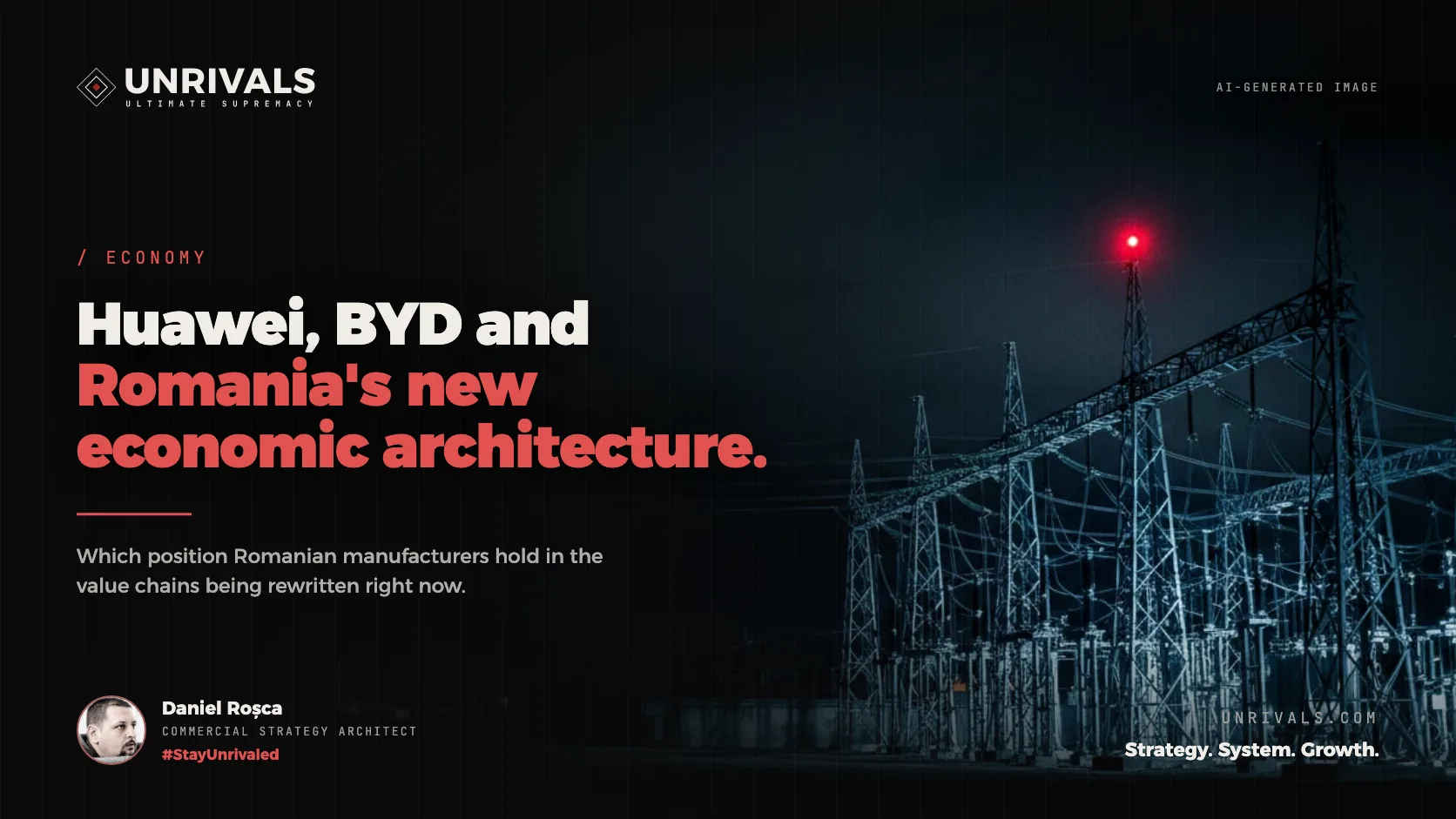
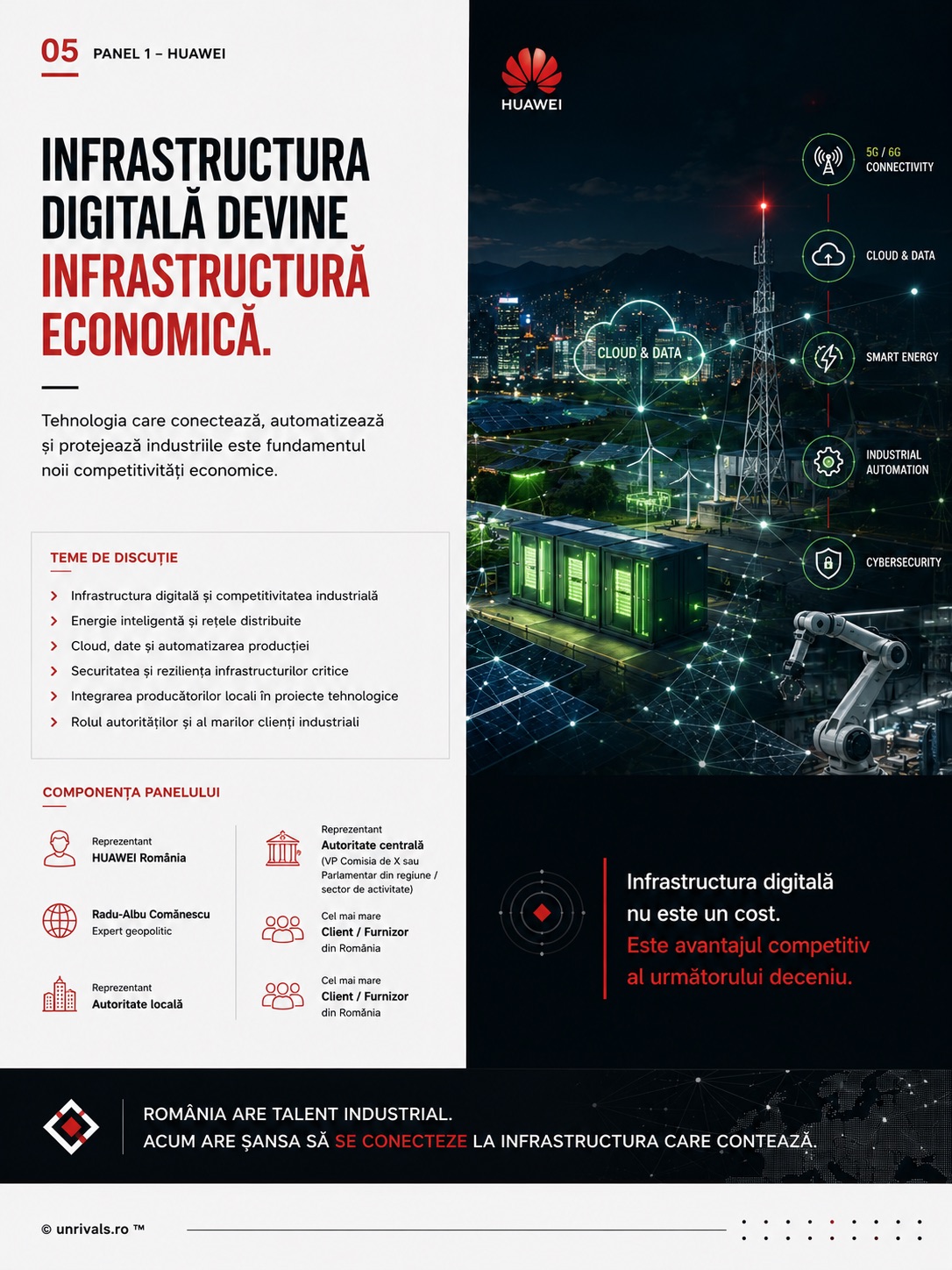
Huawei and BYD are two Chinese companies that control several layers of the same economy at once. Huawei builds digital infrastructure, from networks and cloud to smart energy and industrial automation. BYD builds the industrial infrastructure of electrification, from the battery cell to the finished vehicle. Taken together, they show how an integrated economic ecosystem works today.
TL;DR. Over the coming years, the competitiveness of manufacturers in Romania, and across Central and Eastern Europe, will rest less on labour costs and energy prices. It will rest on the position they hold in the industrial ecosystems being built around digital infrastructure, energy and integrated production.
A supplier that sells capacity stays replaceable, while a supplier that owns one of the customer’s problems becomes a system partner. That shift is the subject of this article.
The world is reorganising around an economic architecture in which technology, digital infrastructure, energy, production and market access work as one interconnected system. Two decades ago, competitive advantage in European manufacturing was built almost entirely on cost and installed capacity, and that was the promise Central Europe made to the rest of the continent.
Today, the difference between economies that generate value and economies that remain assembly platforms or consumer markets comes from the position they hold inside the new ecosystems.
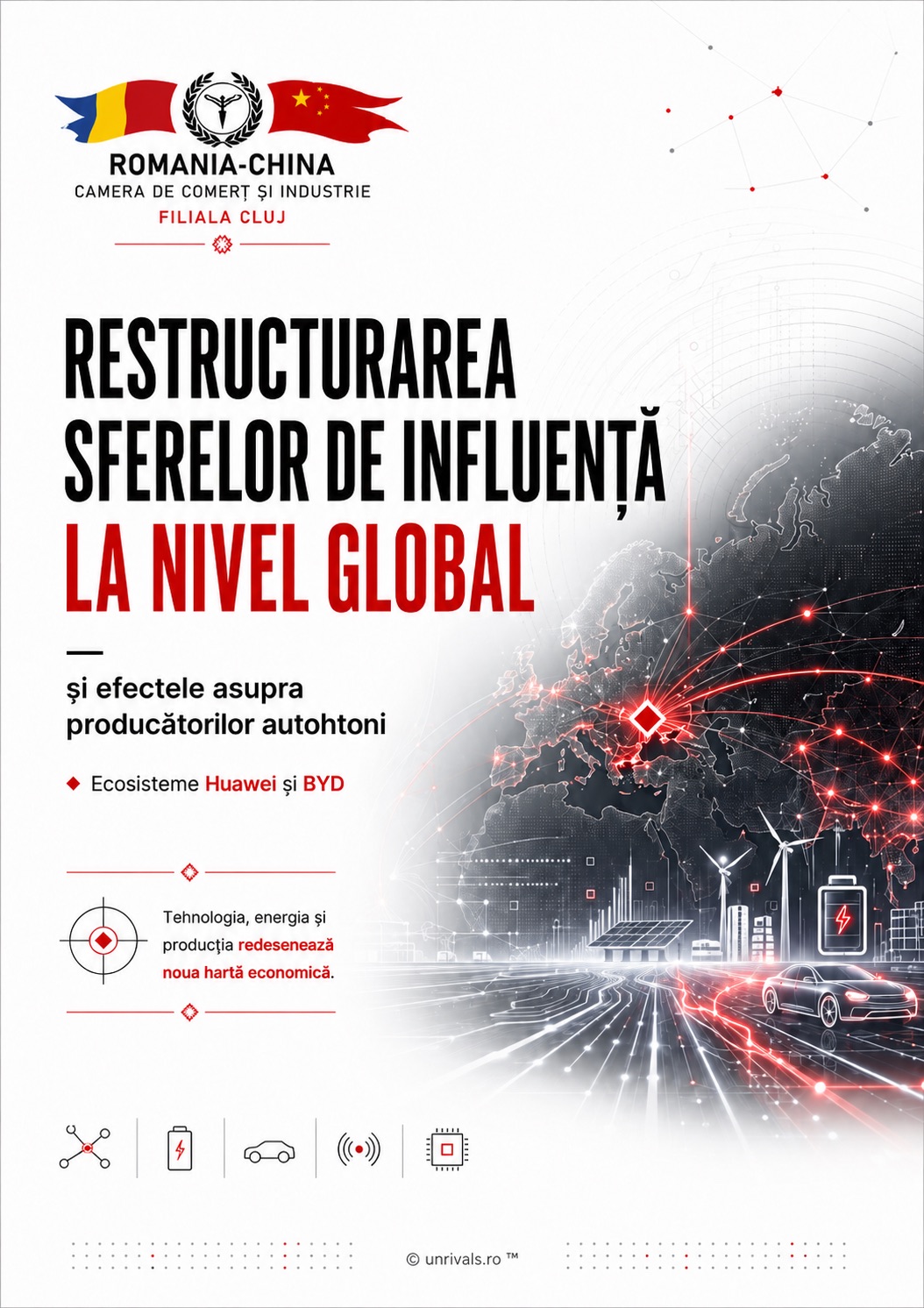
That is the central idea of the conference “The Restructuring of Global Spheres of Influence and Its Effects on Local Manufacturers” (our translation of the Romanian title), organised by the Romania–China Chamber of Commerce and Industry, Cluj branch, on a strategic positioning built together with UNRIVALS.
This article starts from the analysis prepared for that conference and carries it further, to the decisions a mid-sized manufacturer can take in the next quarter. We use the method we apply in our own positioning analyses, with examples from Romanian companies we have analysed in public.
What do Huawei and BYD have in common?
Huawei and BYD share simultaneous control over several layers of the same economic system. Each layer reinforces the next, and the resulting advantage is hard to copy, because a competitor would have to rebuild the whole chain at once. That sets them apart from the classic multinational, which usually excels at a single link.
Huawei is the backbone of digital infrastructure. Connectivity, cloud, artificial intelligence, smart energy and industrial automation form one infrastructure at Huawei, on which other industries then run. According to Huawei’s 2024 annual report, the company generated CNY 862.1 billion in revenue, 22.4% more than the year before.
From that revenue, Huawei reinvested CNY 179.7 billion in research and development, or 20.8% of the total. On 31 December 2024, around 113,000 people, roughly 54.1% of the workforce, worked in R&D, according to Huawei’s 2024 annual report.
A company that puts a fifth of its revenue back into research ends up writing standards, and standards decide whose infrastructure everyone else works on.
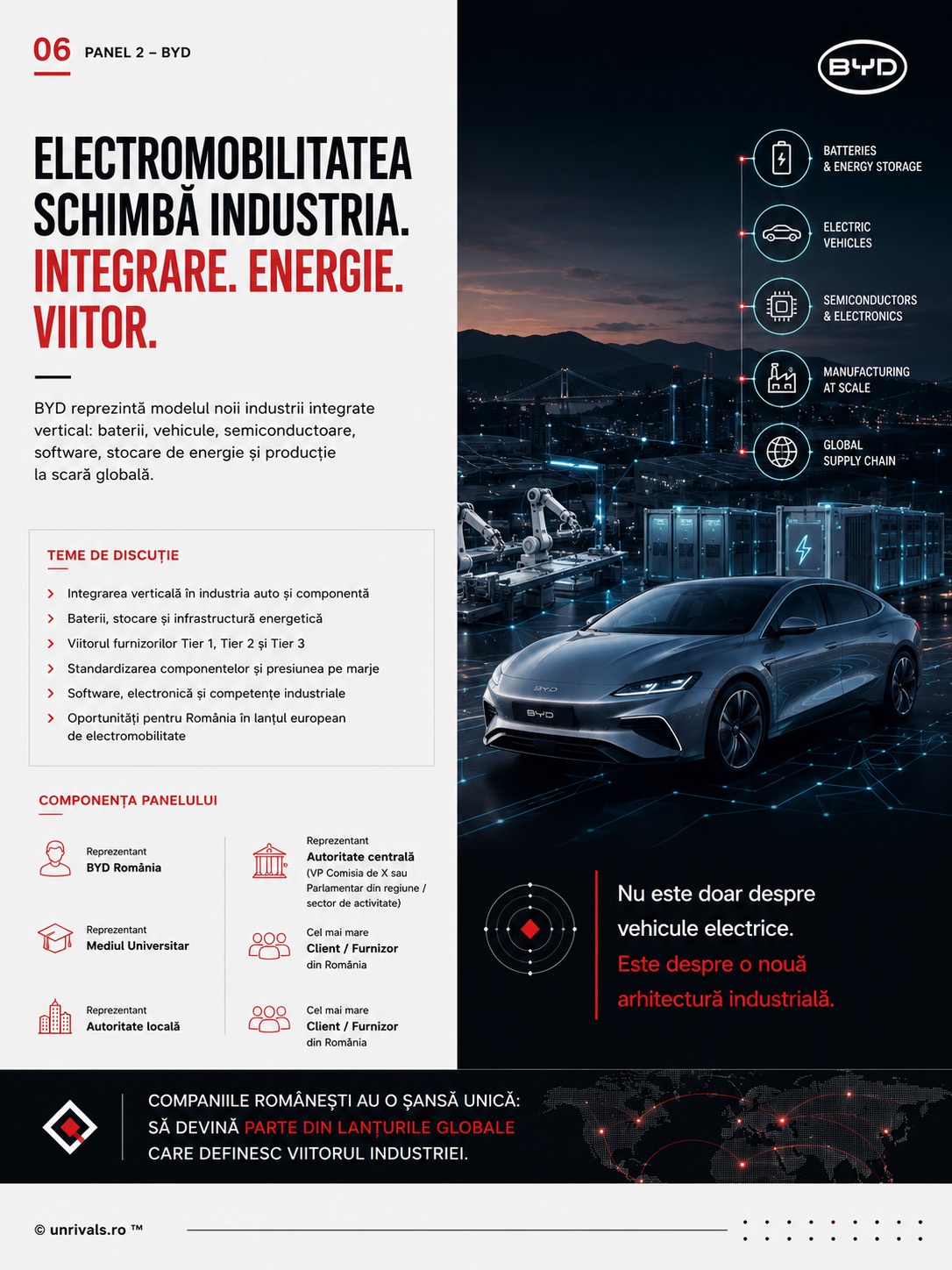
BYD defines another level of the same architecture. Behind the public image of electric cars, the company has built an ecosystem around batteries, energy storage, power electronics and integrated production. The electric car is only the visible expression of a much deeper industrial system, in which energy, software, materials and manufacturing work together.
The result shows up in the market. BYD sold 4.6 million vehicles in 2025, including 2.26 million fully electric ones, while Tesla delivered 1.64 million. For the first time on a calendar-year basis, BYD overtook Tesla as the world’s largest seller of electric vehicles, as CNBC reported in January 2026.
The most interesting point sits where the two ecosystems touch. In August 2024, Reuters reported that the Bao 8 SUV in the Fangchengbao line-up would be the first BYD model to use Huawei’s Qiankun driver-assistance system. One company’s digital infrastructure goes straight into the other’s industrial product.
From that moment, the line between a “technology company” and a “car company” becomes hard to draw. This is the convergence the analysis prepared for the Cluj conference places at its centre, with Huawei on the digital layer and BYD on the industrial and energy layer.
For a manufacturer in Romania, Poland or Czechia, the lesson that matters is the logic by which each layer feeds the next. The sheer size of the two companies is the least useful part of the story, because nobody in the region will match it.
What are the six layers of the new economic power?
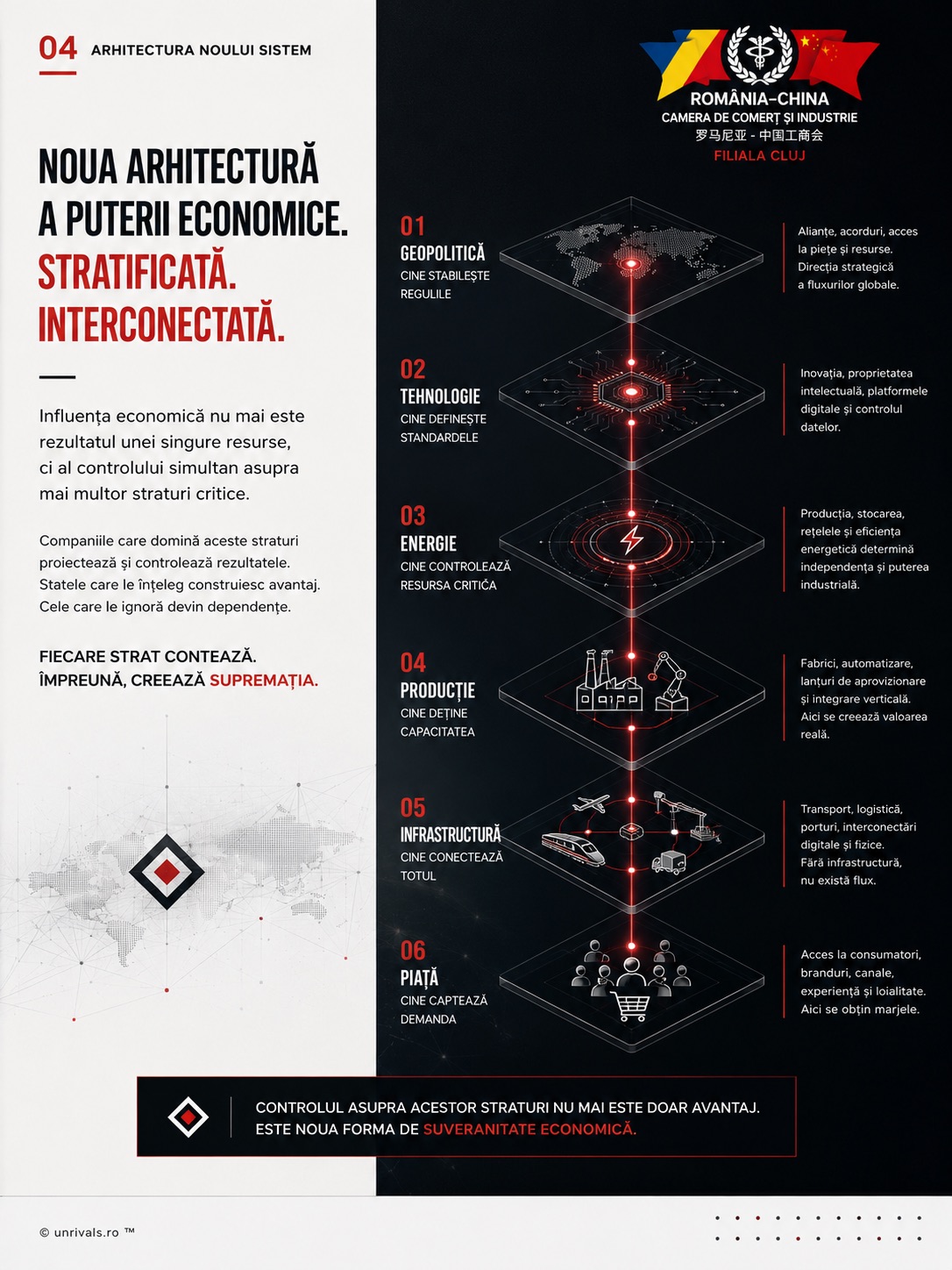
The six layers of the new economic power are geopolitics, technology, energy, production, infrastructure and market. The analysis prepared for the conference starts from the observation that economic power now belongs to actors who control several of them at once. Each layer reinforces the others, and together they produce an advantage that an isolated competitor cannot replicate.
Geopolitics sets the alliances, the trade rules and the direction of the major economic flows. The example closest to any European manufacturer is the EU decision to impose definitive countervailing duties on battery electric vehicles imported from China, through Commission Implementing Regulation (EU) 2024/2754, adopted in October 2024.
The duty set by that 2024 regulation is 17.0% for the BYD group, 18.8% for Geely, 35.3% for SAIC and 7.8% for Tesla, for a period of five years. A decision taken in Brussels changes, overnight, the price at which a product reaches the European buyer.
Technology defines the digital standards, data platforms and information infrastructure on which the modern economy runs, and this is Huawei’s ground. Energy is the layer without which neither digitalisation nor industry can run sustainably. For Romania, and for much of the region, energy is probably the most sensitive layer of all.
“We have expensive electricity that makes us uncompetitive,” Mihai Bordeanu, president of the Romanian carmakers’ association ACAROM, told Ziarul Financiar in November 2025, in our translation. He also gave the concrete gap, saying that Dacia’s plant in Mioveni pays 60% more for power than Renault does in Spain.
Production is where knowledge and technology turn into economic value, and here the map of Europe is shifting in plain sight. BYD began trial production at its plant in Szeged, Hungary, at the start of 2026, its first passenger car factory in Europe.
A vehicle assembled inside the Union is no longer an import from China, so the production layer answers the geopolitical layer directly. For suppliers in Hungary’s neighbourhood, including western Romania, the same move also redraws the map of who might buy from them.
Infrastructure connects physical and digital flows, from data networks to ports and charging stations, and keeps the whole system running. The market is the layer where demand forms and where, in the end, the value created by all the other layers stays.
The European single market has 440 million consumers and 23 million companies and accounts for around 17% of global GDP, according to the Draghi report on European competitiveness, published by the European Commission in September 2024. It is one of the largest markets in the world, and every Central European manufacturer already sits inside it.
The same report, written by Mario Draghi, former president of the European Central Bank, describes China’s strategy without euphemism.
“China is striving for technological autarchy and vertical supply chain integration, from mining of raw materials to processing and from manufacturing to shipping,” Draghi writes in Part A of the 2024 report. The description fits the BYD ecosystem almost perfectly.
Each layer, taken on its own, explains only part of today’s economy. Together, the layers show why competition is moving from single companies to ecosystems able to integrate all six dimensions. The table below places the two companies on the same grid and adds the question each layer puts to a manufacturer in the region.
| Layer | What Huawei controls | What BYD controls | The question for a regional manufacturer |
|---|---|---|---|
| Geopolitics | market access through partnerships and standards | the Szeged plant, inside the Union | Which trade bloc do I sell into, and which rules could change tomorrow? |
| Technology | networks, cloud, AI, the Qiankun system | power electronics and vehicle software | Which technical standard must I meet to enter the chain? |
| Energy | smart energy and storage | batteries and stationary storage | How much of my margin depends on the price of power? |
| Production | industrial automation | vertically integrated manufacturing | What do I do that a supplier in another country cannot do the same way? |
| Infrastructure | connectivity and data centres | charging infrastructure | Which of the customer’s systems does my product support? |
| Market | operators, companies, public institutions | vehicle buyers on several continents | Which customer problem do I own, beyond the specification? |
The last column is the one that matters to the reader of this article. A manufacturer that can answer all six questions already knows where it stands in the chain, while one that stops at the first question usually competes on the price in the quote and little else.
Why do Huawei and BYD matter to manufacturers in Romania?
Huawei and BYD matter to manufacturers in Romania because Romanian industry is already deeply embedded in value chains it does not control. The car industry alone accounts for more than 13% of GDP and about a third of the country’s exports, and in 2024 Romania built around 560,000 cars, according to Ziarul Financiar in November 2025.
That 2024 output was a record and, according to the same 2025 source, lifted Romania to sixth place among European car producers.
Both plants that build these cars, in Mioveni and in Craiova, belong to foreign groups, so the decisions on platforms, technology and sourcing are taken outside the country. The pattern will be familiar to anyone who runs a supplier in Slovakia, Hungary or Czechia.
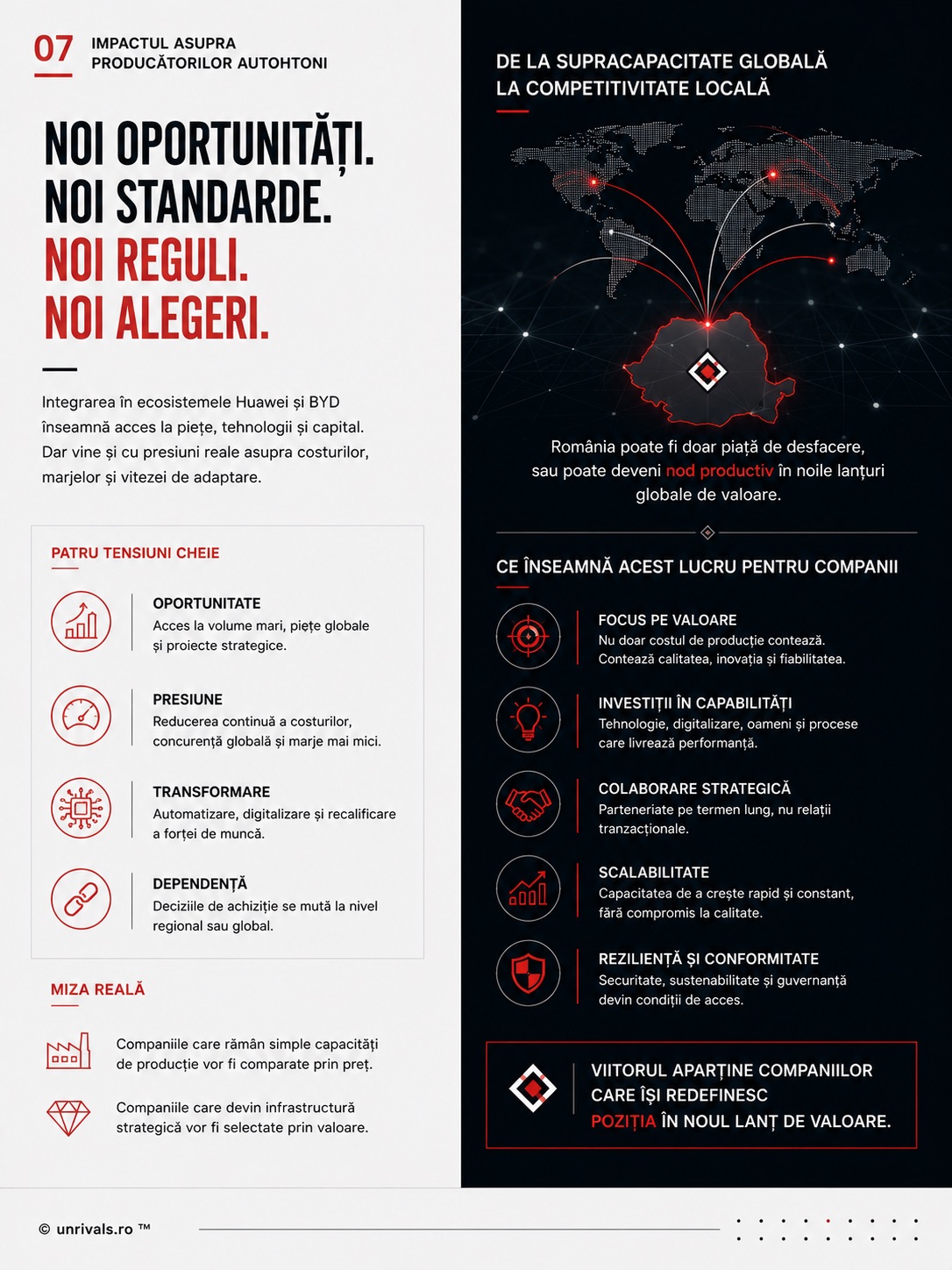
For suppliers in these chains, the consequence is direct. They often compete on cost, lead time and capacity, which are exactly the criteria a supplier in another country can match at any moment. Companies that stay there live under permanent pressure on margins and under the threat of production moving to a lower-cost location.
We have described this mechanism at length in our piece on price wars as a problem of perception. In short, a buyer compares on price only when there is no other criterion to compare on, and the missing criterion is almost always the position the supplier never put into words.
We also checked how the Romanian market sees the two names, with a measurement of our own. In September 2026, using Google Ads search volumes pulled through DataForSEO, “byd romania” had around 22,200 monthly searches in Romania, while the combination “huawei byd” had roughly 10. These figures are ours, measured for this article.
The gap says something important about how a market perceives a company. People search for the product, the car they can buy, and almost never for the system that makes it possible. The same happens to an industrial supplier, whose customer sees the part delivered while the systemic value stays invisible as long as nobody names it.
What does it mean to move from cost supplier to system partner?
Moving from cost supplier to system partner means changing the unit of value you sell. A cost supplier sells a part, a machine hour or a tonne of material. A system partner sells an outcome the customer cannot afford to lose, and is chosen for the risk it takes out of the customer’s operation.
The reason this matters starts with the buyer. Inside an integrated ecosystem, the industrial buyer looks for partners that take responsibility for part of the system, because every weak link can stop the line. A capacity supplier solves an order, and a system partner removes a worry.
This is where the Golden Circle logic comes in, and we apply it in every positioning analysis. Most manufacturers describe themselves by what they do, meaning cutting, welding, injection moulding, assembly. The system partner starts from why its product exists in the customer’s operation, meaning from what it protects.
The clearest example comes from a positioning analysis we published for Cablero Steel Group, a Romanian maker of steel wire ropes and lifting equipment based in Iași. The first line of its homepage promised free delivery, free advice and fast shipping.
Those are retail promises, and they placed the manufacturer in the same category as the shops that resell its goods.
The real proof existed, buried out of sight, as the Cablero positioning analysis shows.
Its references as a supplier to Renault, UAMT and Dedeman, its certifications and its capacity to produce one linear metre of wire rope every 1.6 seconds were all published, yet none of them appeared on the first page.
The position we proposed, in our translation from the Romanian deck, was “We don’t sell the cable. We sell what is not allowed to fail.”
That sentence moves the unit of value from the product to the continuity of an operation in which a failure can stop production or cause an incident. The cable stays the same, yet the buyer starts comparing suppliers by the risk they remove, and there the price per metre matters far less.
The second example comes from the analysis we published for Stelco Romania, a metal-processing company in Brașov county that works for machinery makers. Its website described laser cutting, bending, welding, machining, surface preparation and powder coating as six separate services, on six separate pages.
Our diagnosis read “The factory delivers the whole structure. The brand sells six processes.” The direction we proposed was “Six processes. One responsibility.” At the scale of a company in Brașov, this is exactly the move Huawei and BYD make at global scale, bringing several links of the chain under a single responsibility.
Neither move requires new investment in the factory. In both cases the advantage already existed in the operation, and what was missing was the language that makes it visible to the buyer.
It is one of the patterns we meet most often in our analyses, a company that says quality, good price and fast delivery, which is the minimum definition of its category.
Which layer of a company decides its place in the value chain?
A company’s place in the value chain is decided on the positioning layer, and the other layers carry it out. The UNRIVALS method works on four layers, numbered from the bottom up. L1 is performance marketing, L2 is revenue and the commercial process, L3 is orchestration and memory, and L4 is positioning and category architecture.
We build from the bottom up, because that is how a company matures, and we derive the message from the top down, from positioning to offer and then to advertising.
L1 is performance marketing, meaning ads, trade fairs, catalogues and traffic, measured by cost per lead and cost of acquisition. Many manufacturers try to solve a positioning problem here, with more ads and more booths at more fairs. The result is more visibility for the same cost-supplier message.
L2 is revenue and the commercial process, meaning quoting, the pipeline, the person who talks to the procurement engineer and the way the offer is written. A system partner quotes differently from a capacity supplier. It describes the responsibility it takes on and the risk it removes from the customer’s operation, alongside the unit price.
L3 is orchestration and memory, where the AI Brain sits, the system that keeps the company’s method, data and history in one place. A newer shift also shows up here.
An industrial buyer now increasingly asks an AI engine who makes a given thing in a given country. A company without pages that answer that question does not exist in the answer.
We saw this effect in the Stelco analysis, where the same question asked in two languages produced opposite verdicts. In English the company came first, and in Romanian it did not appear at all. For a manufacturer selling into European chains, this layer decides whether it makes the shortlist before any commercial conversation begins.
L4 is positioning and category architecture, where the company decides which customer problem it owns and in which category it wants to be compared. Huawei and BYD work from the top down, starting from the category they build. Most manufacturers in the region work from the bottom up and rarely reach the top layer.
Yet that top layer is where their place in the chain is decided. We explain how the four layers connect in our article on how a company’s marketing architecture works.
For the subject at hand, the conclusion is simple, a company that wants to become a system partner works on L4 first, then on L2, and only at the end on L1, which amplifies a decision already taken.
What does the UNRIVALS method say about industrial ecosystems?
Our method says that a company becomes part of an ecosystem through position more than through capacity. Its principles are collected in the Codex Rosca, the doctrine we use in every analysis, and four of the Codex pillars apply directly to the Huawei and BYD lesson.
Cognitive ownership. The pillar states that the ultimate goal is to own the mental space of the category, so that when the need arises, the market comes to you on its own, without competing on ads and price.
At its own scale, BYD applies exactly this principle, because it sells a whole category first, electrification from battery to vehicle, and only then models.
For a manufacturer in the region, the equivalent question sounds like this. When a procurement engineer at a carmaker or a machinery producer has a certain kind of problem, which company in your country comes to mind first?
If the answer is not your name, the cognitive ownership of the category belongs to someone else, and you enter the conversation only through a tender.
Infrastructure before marketing. The pillar states that a client rarely has a marketing problem and far more often lacks infrastructure, meaning systems, channels, positioning and a brand foundation, and that marketing built on a weak base burns money. Huawei is, quite literally, an infrastructure company, and its whole story confirms this order.
Applied to a Central European manufacturer, the pillar means that international standards, visible certifications, pages that answer the buyer’s questions and a clearly stated position all come before the next trade fair. An expensive booth at a German fair, built on the message “quality and competitive prices”, buys attention for a sentence any competitor could sign.
Brand as a foundation for growth. The pillar states that on the right foundation every unit of money invested stays as active memory, while nothing remains from ephemeral advertising, so the foundation is built first.
For a B2B manufacturer, that foundation is the central attribute it wants to be compared on, said the same way in every quote, catalogue and meeting.
Every offer sent on the same attribute adds something to the buyer’s memory, and every offer sent on a generic message is lost with the tender. We show how this mechanism works for industrial companies in our article on B2B branding and the industrial buyer’s decision.
Efficiency through strategy. The pillar states that the marketing budget exists for development, meaning strategy and architecture, and that endlessly optimising the same channel leads to the same ceiling. The right strategy lowers the real cost of winning a customer, whereas tweaking an ad only moves it by a few percent.
For a cost supplier, the equivalent of optimisation is the price cut. Each discount wins an order and lowers the ceiling for the next one. The move towards system partner is the development investment, and the order in which it happens is set out in our guide to marketing strategy for companies above €3 million.
How did the Romania–China Chamber of Commerce build a position rather than an event?
The Romania–China Chamber of Commerce and Industry, Cluj branch, built a position by creating a context before communicating the event. The strategic positioning developed with UNRIVALS started from a simple idea, that an organisation must first build a frame that gives it relevance and continuity, and only then announce a conference.
That is why the event brochure follows a logical thread in place of a traditional presentation. It starts with the restructuring of global spheres of influence, explains the new architecture of economic power, introduces Huawei and BYD as case studies and ends with the concrete implications for Romanian manufacturers and for lasting economic partnerships.
The most visible layer of the positioning is a shared cultural code. Cucuteni in Romania and Yangshao in China are two Neolithic cultures that, thousands of kilometres apart and with no contact, painted almost identical pottery.
In the brochure, the Cucuteni vessel opens the material for Romanian readers, and the Yangshao vessel closes it for Chinese readers, so each decision-maker sees that the material speaks their language.
The Chamber’s rewritten promise became “we build economic trust between two markets through a shared cultural code.” The whole path, from diagnosis to brochure, is described in the Romania–China Chamber of Commerce case study, which we published as proof of the method.
The Chamber’s contact person for the project is Dr. Eng. István Szőke, vice-president of the Cluj branch, listed as such in the conference brochure. The direction we built together with the Chamber starts from a simple idea, that Romania builds its competitiveness through partnerships, infrastructure development, higher technological capability across industry and the integration of Romanian manufacturers into ecosystems that generate long-term value.
The outcomes the event sets out to achieve are direct dialogue, pilot projects, B2B meetings and collaboration between universities and industry.
What can a manufacturer do in the next 90 days?
A manufacturer can start the move towards system partner without new budget, through four moves that rest on what it already has. We use them in the same order in our positioning analyses, because each move prepares the ground for the next.
The first move eliminates parity statements. “Quality, competitive prices, fast delivery” describes the whole category, and a buyer who reads the same sentence on five websites ignores all five. The test is simple, since a sentence a competitor could publish tomorrow without lying is not a position.
The second move reduces the weight of channels where you are compared on price alone, such as open tenders and catalogue-style sourcing platforms, wherever you do not yet have an argument that shifts the comparison. You do not abandon them overnight, you simply stop treating them as the main source of growth.
The third move raises proof to the level of the main message. Certifications, reference customers you can name in public, measurable capacities and years of operation without incident already exist in most manufacturing companies. They usually sit on a secondary page, where nobody sees them at the moment of decision.
The fourth move creates the pages that answer the buyer’s questions before the request for quotation, so that AI engines and human buyers have something to cite. Then comes a rule from our method, one product, one channel, ninety days, after which you measure turnover, the average price achieved and the enquiries that arrive by name.
If you want to see which layer is blocking your company’s position, and how it compares with your three closest competitors, request an audit.
What founders tell us about competition from abroad
We often talk with founders who see more and more competitors around them, some with a strength their company cannot match. Some of them are looking for a price position they can defend without moving into premium territory.
Behind that search is the wish to be compared on something other than price. Huawei and BYD show another direction, in which a company builds its position on the risk it takes off the customer, and the buyer chooses it for that reason.
Frequently asked questions
Why are Huawei and BYD relevant to a mid-sized European manufacturer?
They are relevant because they show what an integrated economic ecosystem looks like today, with technology, energy, production and market reinforcing each other. A mid-sized manufacturer will not replicate these models, yet it can understand their logic and define its own role in a value chain that is being rewritten now, instead of remaining a capacity supplier.
What is a global value chain?
A global value chain is the path a product follows from raw material to end buyer, through companies in several countries. Each link adds value, yet most of the margin stays with those who control the technology, the standards and the relationship with the market. Your position in the chain decides how much of the value created stays with you.
Can a mid-sized company become a system partner?
Yes, and the examples in this article are Romanian manufacturers far below the scale of Huawei or BYD. The move requires less an investment in the factory and more a positioning decision, followed by visible proof and by an offer that describes the responsibility taken on, alongside the unit price.
What does positioning mean for a B2B manufacturer?
Positioning for a B2B manufacturer sets the criterion by which it wants to be compared by the buyer. Specifications, certifications and capacities remain necessary, yet they are the proof. Positioning decides what that proof has to demonstrate, so that every capability reinforces the same conclusion in the buyer’s mind.
How long does the move from cost supplier to system partner take?
The first effects can be measured after a ninety-day test on a single product and a single channel, through the average price achieved and the enquiries that arrive by name.
The full move takes longer, because a market’s memory is built through repetition. From the start, our method shows the order of magnitude of what is at stake, calculated from public figures, without promising a specific result.